

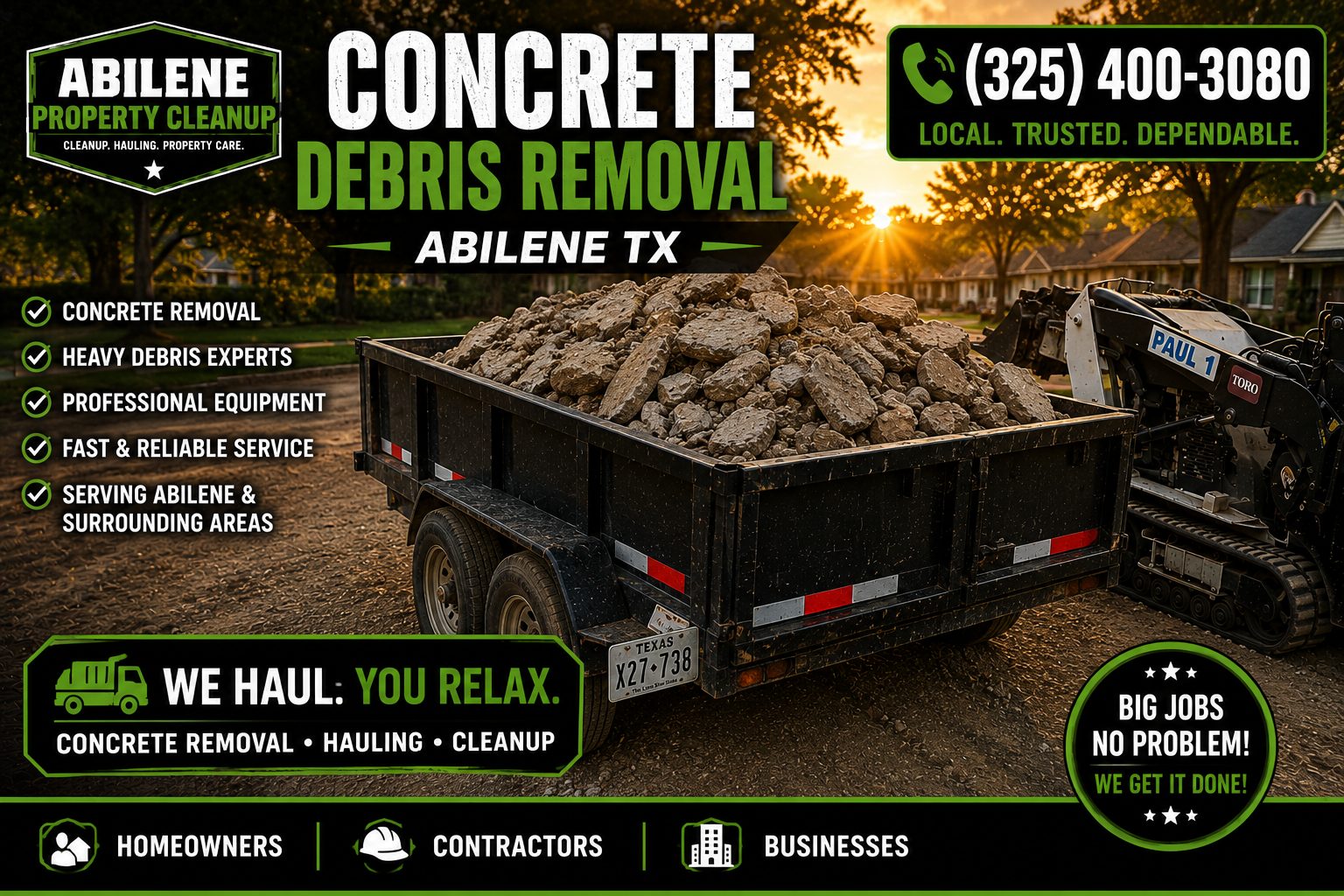
Concrete Debris Removal Abilene TX
Concrete debris removal in Abilene, TX is for manageable quantities of broken concrete, brick, pavers, and masonry already separated into loadable pieces. This service helps homeowners, landlords, contractors, and property managers clear heavy debris after patio, sidewalk, fence-post, landscaping, and small repair projects. Because concrete reaches trailer weight limits quickly, every load is evaluated by piece size, total weight, access, and disposal requirements. Send clear photos and measurements before scheduling so the job can be reviewed accurately.
Broken concrete is one of the most difficult materials to remove because it is dense, abrasive, and heavy. A pile that looks small can weigh far more than expected, which makes safe loading and trailer capacity especially important.
Abilene Property Cleanup provides concrete debris removal for approved ground-level loads in Abilene and nearby Big Country communities. Call or text (325) 400-3080 with photos of the pile and access route.
Concrete Debris Removal at a Glance
| Best For | Patio removal, sidewalk repair, fence-post work, landscape renovation, and small masonry projects |
|---|---|
| Typical Materials | Broken concrete, pavers, brick, block, curb pieces, and masonry fragments |
| Required Condition | Already broken into manageable pieces |
| Loading | Available for approved debris in accessible ground-level areas |
| Main Limitation | Weight capacity, piece size, access, and safe handling |
| Service Area | Abilene and nearby Big Country communities |
Who Uses Concrete Debris Removal
| Customer | Common Project | Typical Material |
|---|---|---|
| Homeowners | Patio, walkway, edging, or landscaping updates | Broken slab pieces, pavers, brick |
| Landlords | Rental repairs and damaged hardscape cleanup | Concrete fragments, block, curb pieces |
| Property Managers | Grounds improvement and maintenance projects | Sidewalk pieces, pavers, masonry |
| Fence Contractors | Old post and footing cleanup | Concrete footings and post-base debris |
| Landscapers | Removal of edging, pavers, and old hardscape | Pavers, retaining blocks, broken concrete |
| Small Contractors | Post-repair or small demolition cleanup | Concrete, brick, block, rubble |
Concrete and Masonry Materials We May Remove
- Broken concrete pieces
- Small slab sections already separated from the ground
- Patio and walkway fragments
- Sidewalk repair debris
- Pavers and landscape blocks
- Brick and masonry fragments
- Curb and edging pieces
- Concrete fence-post footings
- Small demolition rubble
All materials must be non-hazardous, reasonably sized, and located where they can be loaded safely. Very large chunks, reinforced slabs, buried concrete, or oversized commercial loads may require a specialized heavy-material contractor.
What Is Included
- Photo-based review of the debris and loading route
- Evaluation of estimated volume and weight
- Loading of approved, accessible pieces
- Securing the heavy load for transport
- Hauling to an appropriate disposal location
- Basic cleanup of the approved pickup area

What Is Not Included
- Breaking or cutting concrete slabs
- Structural demolition
- Excavation or removal of buried foundations
- Jackhammer work
- Roof, ladder, or elevated removal
- Hazardous or contaminated material handling
- Oversized industrial or commercial concrete loads
- Loads that exceed safe trailer or equipment limits
Why Concrete Debris Requires Special Planning
Concrete removal is different from ordinary junk or light construction debris. Trailer space is not usually the first limit—weight is. Dense materials can reach safe hauling capacity long before the trailer appears full.
Piece size also matters. Small, separated chunks can often be handled more efficiently than thick slabs, large footings, or pieces with long sections of exposed rebar. Access, slope, mud, gates, and carrying distance can also determine whether the job is safe and practical.
How the Concrete Debris Removal Process Works
- Send photos and measurements. Show the entire pile, close views of the pieces, and the path to the loading area.
- Review weight and access. We evaluate likely weight, piece size, slope, gate width, ground conditions, and disposal requirements.
- Confirm the service scope. The concrete must already be broken into manageable pieces unless specifically discussed.
- Schedule the pickup. Timing depends on trailer capacity, route availability, weather, and disposal hours.
- Load approved materials. Concrete and masonry are loaded from the agreed ground-level area.
- Haul and dispose. The load is secured and transported to an appropriate facility.
Concrete Debris Preparation Checklist
| Preparation Step | Why It Matters |
|---|---|
| Break concrete into manageable pieces | Large slabs may be unsafe or impossible to load |
| Stack pieces in one accessible area | Improves evaluation and reduces loading time |
| Separate soil, trash, and vegetation | Keeps the heavy-material load clean and easier to assess |
| Cut or control exposed rebar | Reduces sharp-edge and handling hazards |
| Clear gates, driveways, and pathways | Improves equipment and loading access |
| Keep vehicles away from the pickup zone | Provides a safe loading area |
| Send updated photos if the pile changes | Helps prevent weight and pricing surprises |
Concrete Debris Removal Pricing Factors
Concrete debris removal is priced differently from light junk because weight has a much larger effect on hauling and disposal. Main pricing factors include:
- Total estimated weight
- Number and size of pieces
- Presence of rebar or sharp reinforcement
- Distance from the pile to the trailer
- Gate width, slope, mud, or uneven ground
- Labor and equipment required
- Disposal facility fees
- Travel outside the Abilene service area
Photos, measurements, and an honest description of the material provide the best starting point for an estimate.
Light Debris vs Concrete Debris
| Factor | Light Debris | Concrete Debris |
|---|---|---|
| Main capacity limit | Trailer space | Trailer weight |
| Common examples | Boxes, trim, light lumber | Concrete, brick, block, pavers |
| Loading concern | Volume and loose pieces | Piece weight and safe handling |
| Disposal cost | Often volume-based | Often weight-sensitive |
| Best preparation | Bagged or stacked | Broken, separated, and accessible |

DIY Concrete Disposal vs Professional Removal
| Consideration | DIY Disposal | Professional Removal |
|---|---|---|
| Vehicle | Requires a truck or trailer rated for the weight | Hauling equipment is provided for approved loads |
| Loading | You handle every piece | Loading is available within the approved scope |
| Weight risk | You must estimate and stay within limits | Load size is reviewed before hauling |
| Disposal | You locate and visit the correct facility | Approved debris is transported for disposal |
| Best fit | Very small quantities and easy access | Manageable heavy loads that require hauling help |
Why This Service Saves Time
Concrete cleanup can involve repeated lifting, short trailer trips, disposal lines, and uncertainty about load weight. Trying to move too much at once can damage equipment or create an unsafe hauling condition.
Professional removal combines job review, loading, transportation, and disposal into one coordinated service. This is especially useful when the area must be cleared before landscaping, fence installation, a property showing, or the next phase of construction.
Common Concrete Removal Mistakes
- Assuming a small-looking pile is lightweight
- Leaving slab pieces too large to load safely
- Mixing dirt, household trash, and vegetation into the concrete
- Failing to mention exposed rebar or wire mesh
- Blocking access with vehicles, trailers, or stored materials
- Adding more concrete after receiving an estimate
- Placing debris on soft, muddy, steep, or unstable ground
- Waiting until the day before a project deadline to schedule removal
Concrete Debris Removal vs Related Services
| Service | Best For | Key Difference |
|---|---|---|
| Concrete Debris Removal | Broken concrete, brick, pavers, and masonry | Focused on dense heavy-material loads |
| Construction Debris Removal | Mixed remodeling and job-site materials | Broader construction debris scope |
| General Debris Removal | Mixed debris from property cleanup | Covers several debris types |
| Bulk Debris Removal | Large-volume piles | Volume is the main service concern |
| Renovation Debris Removal | Kitchen, bathroom, flooring, and interior updates | Focused on remodeling situations |
Concrete Debris Removal Across Abilene and the Big Country
Service is available throughout Abilene, including properties near South 14th Street, Buffalo Gap Road, Antilley Road, Sayles Boulevard, Ambler Avenue, Judge Ely Boulevard, North 1st Street, South 1st Street, Loop 322, Highway 277, Winters Freeway, and I-20.
Nearby availability may include Tye, Potosi, Buffalo Gap, Clyde, Merkel, Tuscola, Baird, Hawley, Taylor County, and surrounding Big Country communities. Heavy-material jobs outside Abilene are evaluated carefully because travel distance and disposal location affect capacity and pricing.
Why Choose Abilene Property Cleanup
- Local service focused on Abilene and nearby communities
- Clear review of weight, access, and piece-size limitations
- Photo-based evaluation before scheduling
- Ground-level loading for approved heavy debris
- Honest communication about loads that require another provider
- Practical service for homeowners, landlords, contractors, and property managers
Frequently Asked Questions
What types of concrete debris do you remove?
We may remove manageable quantities of broken concrete, small slab sections, pavers, brick, curb pieces, landscape edging, masonry fragments, and similar non-hazardous heavy debris. Final acceptance depends on piece size, total weight, access, trailer capacity, and disposal rules.
How much concrete can you haul away?
Concrete is extremely heavy, so the amount that can be hauled safely is often limited by weight rather than trailer space. Clear photos and approximate dimensions help determine whether the load fits the available equipment.
Do you break up concrete slabs?
No. This service is for concrete that has already been broken into manageable pieces and placed in an accessible ground-level area. Structural demolition and slab breaking are not included.
Can you remove concrete from a backyard?
Possibly. Backyard jobs are evaluated based on gate width, ground conditions, slope, carrying distance, obstacles, and whether equipment can safely reach the debris.
Do you remove concrete with rebar attached?
Small pieces with limited exposed rebar may be considered, but sharp or tangled reinforcement can make loading unsafe. Send close photos so the material can be reviewed before scheduling.
Can you take bricks, blocks, and pavers with concrete?
Yes, manageable quantities of brick, block, pavers, and masonry may be accepted with concrete. Mixed heavy-material loads still require weight and disposal evaluation.
How is concrete debris removal priced?
Pricing depends primarily on total weight, piece size, loading difficulty, access, travel, labor, and disposal fees. Dense debris often costs more to remove than lighter materials that occupy the same amount of space.
Can I get an estimate from photos?
Yes. Send wide photos of the full pile, close photos showing piece size and material type, and photos of the route from the pile to the loading area. Measurements or an estimated number of wheelbarrow loads can also help.
Do you offer same-day concrete removal?
Same-day service is not guaranteed. Heavy-material jobs require enough trailer capacity, disposal availability, safe loading conditions, and route time.
What concrete-related materials are not accepted?
We do not accept asbestos-containing material, contaminated concrete, unknown industrial debris, hazardous chemicals, sealed containers, fuel, or loads that exceed safe equipment limits.
Do you serve areas outside Abilene?
Availability may extend to Tye, Potosi, Buffalo Gap, Clyde, Merkel, Tuscola, Baird, Hawley, and nearby Big Country communities depending on load size, route, and disposal requirements.
What is the difference between concrete debris removal and general debris removal?
Concrete debris removal is specifically planned around dense, heavy materials where weight limits, piece size, equipment access, and disposal charges are the main concerns. General debris removal covers a broader range of lighter or mixed property debris.
Related Debris and Cleanup Services
- General debris removal in Abilene
- Construction debris cleanup for repair and job-site materials
- Residential debris removal for homes and yards
- Commercial debris removal for business properties
- Property debris cleanup for vacant and neglected properties
- Wood debris removal for lumber, fencing, and remodeling scraps
- Renovation debris removal for interior updates
- Bulk debris removal for larger piles
- Full-service junk removal in Abilene
Schedule Concrete Debris Removal in Abilene
Send clear photos of the entire pile, close views of the concrete pieces, approximate measurements, and photos of the route to the loading area. Mention rebar, slopes, narrow gates, soft ground, or unusually large pieces.
Call or text (325) 400-3080 to find out whether the concrete load fits the service and to discuss the next available scheduling option.